Fill Level Detectionfor Bottling Lines
Qualens helps teams detect underfill, overfill, and inconsistent fill levels using cameras and computer vision—so QA catches real level defects with fewer false rejects on high-speed filling lines.
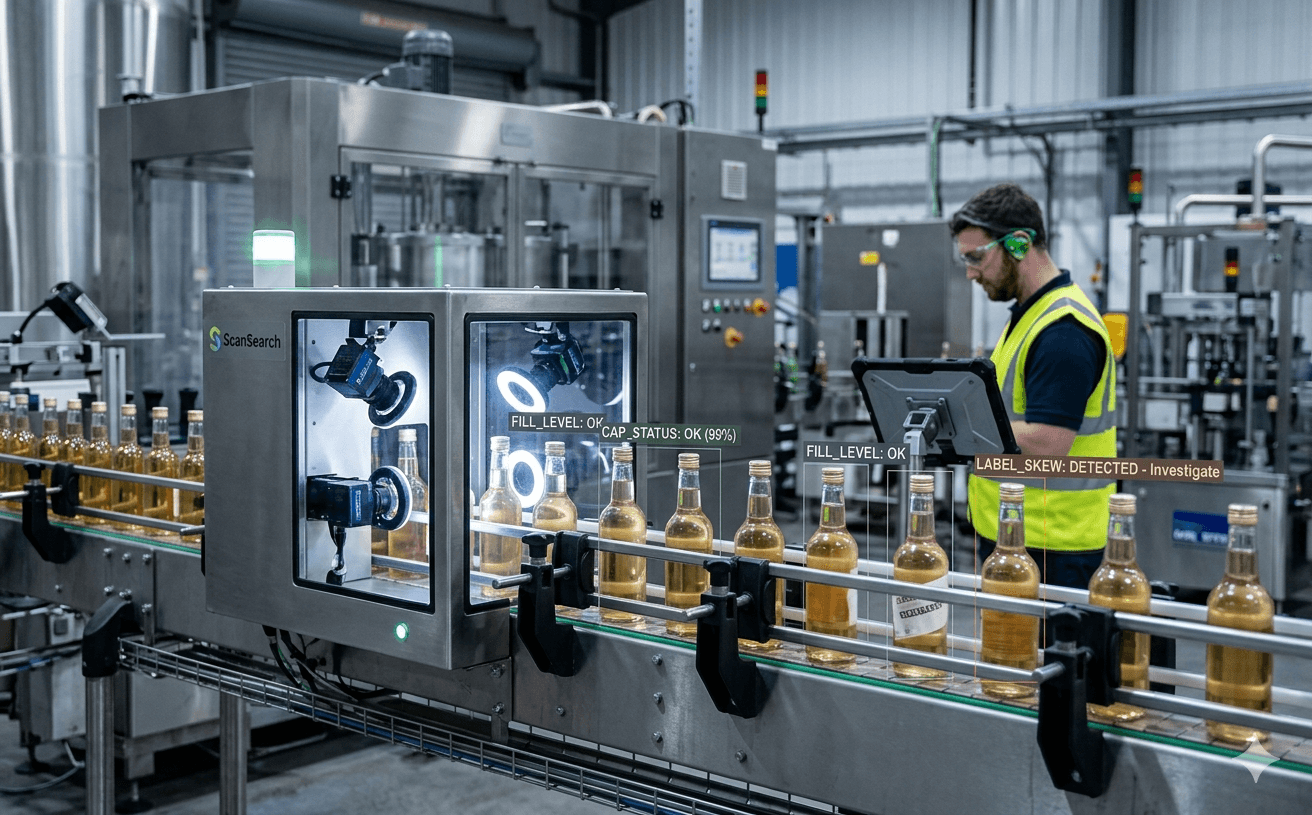
Station
Post-fill
Level
Review
Inspection objective
Catch underfill and overfill with stable, review-friendly vision events
What it means in practice
Fill level detection is about reliable level checks at line speed
In practice, teams need to know when bottles are short-filled or overfilled before they leave the critical zone—without drowning in false rejects every time foam, light, or a new SKU appears.
Spot underfill and overfill visually
Fill level detection means identifying bottles or containers that are visibly underfilled, overfilled, or outside an acceptable level band before they leave the station or reach the case packer.
Reduce brittle threshold rejections
Traditional rule-based checks often fight lighting, foam, condensation, and SKU variation. Vision tuned for fill behavior can reduce false rejects while still flagging real level issues.
Align with line speed and station layout
The use case is practical when the fill zone or post-fill view is stable enough for cameras: filler exit, inspection bridge, or a dedicated level check station.
Support traceability by run and station
When a level event is detected, teams benefit from timestamps, station context, and review-friendly imagery—not only a binary pass/fail without context.
Common operational problems
Fill issues and brittle vision create cost on every run
Fill issues surface too late
Underfill or overfill may only be noticed after samples, customer complaints, or downstream weight checks—after many units have already shipped or been scrapped.
Rule-based vision fights the line
Fixed thresholds struggle when foam, bottle color, cap type, or ambient light changes. That drives false rejects or missed defects when the model is too rigid.
Manual spot checks miss drift
Operators cannot watch every bottle at line speed. Slow drift in fill settings or nozzle behavior can go unnoticed until it becomes a batch problem.
SKU and format changes add retuning cost
Every new bottle height, neck shape, or product foaming behavior can force lengthy vision reconfiguration if the system is not built for variation.
Regulatory and brand risk on short fills
Short fill is a quality and compliance concern in beverage, food, and many industrial liquids. Consistent, explainable detection matters for QA workflows.
False rejects waste good product
Over-sensitive fill checks scrap or rework salable product. Balancing sensitivity with stability is a common pain on high-speed lines.
How cameras and computer vision help
Vision can stabilize fill inspection when the level is visible
Visible fill height and meniscus checks
Use cameras to assess the liquid level relative to the neck, shoulder, or a defined ROI when the fill is optically observable.
Underfill and overfill classification
Separate marginal levels from clearly acceptable fills so QA can focus review on borderline and failed units.
Adaptation across lighting and foam
Modern vision approaches can be less brittle than single-threshold rules when foam, bubbles, or glare appear in the field of view.
Station-synchronized events
Tie fill level events to station ID, lane, and run so root-cause analysis points back to the filler or inspection point.
Exception review with imagery
Give QA a visual record of flagged bottles to speed decisions and reduce arguments about “was it really short?”
Complement in-line weight checks
Fill vision can sit alongside checkweighers and in-line sensors where a visible level check adds confidence or catches cases weight alone misses.
Where this fits best
Strongest fit when the fill is clearly visible after filling
Why visual fill inspection matters
Imagery aligns QA with what the line actually produced
Operational value
Better fill visibility should reduce escapes and wasted good units
How a project starts
Start with one line, one viewpoint, clear level criteria
01
Define the fill defect
Clarify underfill, overfill, or level band rules; which SKUs; and what currently triggers rejects or escapes.
02
Review camera viewpoint and line speed
Assess where the level is visible, exposure, blur, and whether a dedicated inspection point improves reliability.
03
Baseline against current rejects
Compare false reject rate and missed defects with existing methods so the pilot has measurable goals.
04
Pilot on one station or SKU
Validate fill level detection in production conditions before expanding to additional lines or formats.
Related pages
Explore inspection and packaging pages
Automated Visual Inspection
Broader inspection cluster: feasibility, line behavior, and industrial computer vision.
Packaging Inspection with Computer Vision
Adjacent packaging checks: labels, seals, and end-of-line quality.
Automated Visual Inspection for Pharma
Quality-sensitive environments including fill-level language for medical and pharma packaging.
Inspection use cases
Explore defect categories and workflows Qualens supports on the line.
Discuss your line
Share fill level pain points, false reject behavior, and pilot ideas directly.
FAQ
Practical questions about fill level detection
What is fill level detection with computer vision?
It is the use of cameras and software to determine whether a bottle or container’s liquid level is within an acceptable range—typically to catch underfill, overfill, or inconsistent fill relative to a visible reference—on a production line.
Does it replace checkweighers?
Not necessarily. Checkweighers measure mass; vision inspects visible level. Many lines use both. Vision can add value when weight alone is ambiguous or when you want imagery for QA review.
Can it work with foamy or carbonated products?
Sometimes, depending on how stable the meniscus appears in the camera view and line speed. Foam and bubbles are common challenges; feasibility is validated per product and viewpoint.
What about dark liquids or opaque bottles?
Opaque bottles may hide the level from a side camera. Options include different angles, backlighting, or alternative inspection points. Each line needs a visibility assessment.
How do you handle SKU changes?
Pilots usually start with one format. Adaptive or retrainable models can reduce retuning time when bottle height or neck geometry changes, within agreed bounds.
Can we start with a pilot?
Yes. A focused pilot on one station and SKU set is the standard path to prove false reject rate, detection rate, and operational fit.
Need fill level detection on your bottling line?
Discuss underfill, overfill, false rejects, foam or lighting challenges, and a focused feasibility review for vision-based fill inspection.